In January, we said:
With lobbyists already such an imposing force on Capitol Hill, you might think that the Supreme Court would rule against expanding the powers of corporations to spend money influencing politicians and public policy, but you would be absolutely incorrect. Thursday, the US Supreme Court voted 5-4 in favor of Citizens United, a conservative corporation non-profit corporation, to reverse years of legislation forbidding companies to spend money on ads for political campaigns, essentially setting back any campaign finance reform indefinitely.
Corporations can now use their overall profit to support any candidate, PAC, or special interest group publicly, giving them more lobbying power for various issues and more pull over candidates and elected officials. It is paramount to our country's future that elected officials answer to people rather than companies, and this new decision will put the opinions of corporations over constituants.
The Supreme Court's decision has real-world ramifications. This ruling is not disconnected from actual campaigns, rather, it has given way to the brand-new 'Super PAC', whose spending- especially on ads- is practically unlimited.
These PACs have already poured money into the midterms in an unprecedented way. Districts that were previously won with maybe a million dollars spent by all groups involved with every candidate, like Rep. Peter Defazio's, are now multi-million dollar affairs- and these are just the Congressional elections. Imagine what this means for the 2012 presidential race. This sort of inflation of campaign value renders individuals irrelevant. All the power now belongs to the PACs, who are in turn funded primarily by large corporations.

The base problem with the court's ruling is a corporations is not a person. Its owners are, its employees are, but it is not. In America, we treat corporations legally as individuals, but this was never intended to render them equivalent to US citizens. Socially, a corporation is not a person- it cannot vote, and it shouldn't be able to throw money at an election. Even if the idea of a corporation being a person was upheld, therefore keeping the rationale of the decision being one of free speech, it would still not be valid. The entire premise of the first amendement rights is that they are inalienable until they infringe upon the rights of someone else, and the new powers of corporations according to the ruling would decrease the validity of the free speech of an individual. Regardless, a corporation is not a person.
The Koch brothers, raw material moguls who fund politically active groups like the 'grassroots' organization Americans for Prosperity, just have one vote each. Their votes are equal to every other citizens, not inflated due to the millions- or even billions- of dollars behind them. Their access to nearly unlimited funds combined with the new ruling gives the Koch brothers much, much more influence over politicians than everyday constituants.
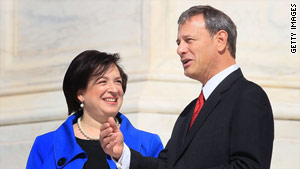
The same is true of every other mogul or corporate group with enough spare funds to fuel a Super PAC. Maybe the new addition of Elena Kagen- whose first official day as a justice last week marks the unprecedented presence of three female justices- will result in the Court reassessing the role of corporations in the increasingly money-based political system, but, in all likelihood, it won't.
[Photo credits: CNN.com and WashintonPost.com]
Late Chief Justice William Rehnquist had not judicial experience prior to joining the Supreme Court, of which he was a member of until his death in 2005. Rehnquist's lack of time as judge is a unusual trait for a judicial nominee, certainly, but hardly unique. Plenty of excellent justices have been chosen who have no or minimal prior judicial experience- in fact, nearly a third of all past justices had never served as a judge before being nominated. Still, it is a helpful, even a desirable trait for a judicial nominee to have served as a judge previously. The true criticism presented by those who feel judicial experience is an important and accurate measure of a nominee is the lack of an attainable record for the nominee's rulings or potential rulings. In all truth, this information could be ascertained from questioning during the Senate confirmation hearing for any nominee, but a nominee's rulings on contentious political issues should not have any effect on their confirmation, except insofar as it demonstrates their devotion to the law.

The next day, Obama announced Elena Kagan, current Solicitor General and first female dean of Harvard Law School. Kagan, like Rehnquist, has no experience as a judge, though she has copious qualifications as an educator and as the primary legal advocate for the federal government. If Kagan is confirmed by the Senate, it will mark the first time three female justices (Sotomayor, Ginsberg, and, potentially, Kagan) will have served on the court at one time.
If a nominee is qualified, devoted to the law, and shows strong moral and decision-based qualities, judicial experience should be superflous. Many years of judicial experience does not necessarily lead to a good justice, and a good justice does not require previous time as a judge. A phenomenal justice differs from a poor nominee based on character, not on irrelevant past decisions.
Read more »
In March of 2009, President Obama nominated former federal court judge Sonia Sotomayor for retiring justice David Souter's spot on the Supreme Court. Souter's unexpectedly left-wing tendencies ensured that Sotomayor's eventual confirmation would not change the makeup of the Supreme Court to any substantive degree. Although minor qualms were made about more contentious statements made by Sotomayor, she was approved by the Senate relatively quickly.
Now, President Obama has been presented with a second opportunity to nominate a Supreme Court justice. As long-time liberal justice John Paul Stevens prepares for his retirement, Obama and the Democratic Senators must prepare for a vicious battle in Congress.
Some in Congress have already made a fuss about the as-yet-unnamed candidate. Congressional Republicans don't want to see another liberal on the court, even if it means keeping the balace of the court in check.
However, the fragile balace of the court must be maintained, even if this means, for Congressional Republicans, the confirmation of a liberal. Still, the Obama Administration may not even nominate a liberal- fear of a bitter partisan battle, especially so soon after the health care debate, might turn them away from promoting a more polarizing person.
The Obama Administration, unless they wish to see more of- and more radical versions of- court decisions like January's on corporations, must nominate someone who is as much an ideologue as Stevens. Although nominating a partisan judge to the land's highest court may not be a popular, nor even a remarkably good decision, it is imperative that the court remains balanced. Stevens was the leader of the liberal wing of the Supreme Court, so if Obama is to appoint a moderate, non-partisan, or even a right-wing judge, the already conservative court will be flung so far right that its future may become unsalvageable.
Read more »
With lobbyists already such an imposing force on Capitol Hill, you might think that the Supreme Court would rule against expanding the powers of corporations to spend money influencing politicians and public policy, but you would be absolutely incorrect. Thursday, the US Supreme Court voted 5-4 in favor of Citizens United, a conservative corporation non-profit corporation, to reverse years of legislation forbidding companies to spend money on ads for political campaigns, essentially setting back any campaign finance reform indefinitely.
Corporations can now use their overall profit to support any candidate, PAC, or special interest group publicly, giving them more lobbying power for various issues and more pull over candidates and elected officials. It is paramount to our country's future that elected officials answer to people rather than companies, and this new decision will put the opinions of corporations over constituants.
Read more »
Ruth Bader Ginsburg
"So that's the dissenter's hope: that they are writing not for today but for tomorrow."
The Liberal Hype site claims no credit for any images featured on this site unless otherwise noted. All visual content is copyrighted to its respective owners. Liberal Hype is in no way responsible for, or has control of, the content of any external website links or embedded streaming videos. Information on this site may contain errors or inaccuracies. If you own rights to any of the content and wish to have it removed please contact at liberalhype@gmail.com. My Tangled Tale, Vinyl, The Dull Drama, First Draft Magician, and other partners are produced by respective owners, and Liberal Hype claims no connection to any information they publish.


 The base problem with the court's ruling is a corporations is not a person. Its owners are, its employees are, but it is not. In America, we treat corporations legally as individuals, but this was never intended to render them equivalent to US citizens. Socially, a corporation is not a person- it cannot vote, and it shouldn't be able to throw money at an election. Even if the idea of a corporation being a person was upheld, therefore keeping the rationale of the decision being one of free speech, it would still not be valid. The entire premise of the first amendement rights is that they are inalienable until they infringe upon the rights of someone else, and the new powers of corporations according to the ruling would decrease the validity of the free speech of an individual. Regardless, a corporation is not a person.


 Posts
Posts

