0 com

PISA

The Race to Nowhere, a film that has resonated so well with American parents, caused so much contention that the New York Times recently hosted an online debate with a spew of academics about the validity of the movie’s argument. Both the movie and the debate follow the same basic premise, one that high school students probably contemplate themselves on those longest working nights: do American high school students get pushed too hard to be the best- if so, how can this be mitigated?
Yes, says psychologist Harris Cooper, in his article submitted for the debate. Too much homework is, well, too much. And while the other five intellectual contributors look at different aspects of the problem, they all are in general agreement with Cooper. That is, no one is contesting the idea the high school students are overworked.
But the comments on the series tell a different story, which is best framed by a reader going by ‘Russell Long’.
“I appreciate [the author’s] views, but am also concerned about the fact that the United States has fallen far behind other nations in global literacy, math and science scores,” he said. “The Times recently reported that the US is 26th in the new PISA scoring, with scores of countries better preparing their kids to compete in the global economy. How do we reduce the educational burdens upon our kids while also improving our languishing performance?”
And therein lies the problem. On the recent international testing, the US scores are an average of just over 90 points below the scores from Shanghai on a 600 point scale. Clearly, the Shanghai numbers are not representative of all of China or even necessarily the average for the city, but they are still astonishing.
Few high-achieving high school students would disagree that they are overworked, and, in all likelihood, they probably are. American society has an overwhelming obsession with being the best, and this focus bleeds into students’ already mounting stress. So the problem is not that top students are not working hard enough, it is that low achieving students are not getting the help they need.
American schools have too many failing students who get lost in the shuffle. Some of them just need a little extra attention, some have serious learning problems. But no matter what the solution is, it is the responsibility of the schools to help them to their best ability.
Reducing the stress of overworked, top-achieving students is a noble task. The student-stress reduction plans- reduce homework, strengthen homeschooling programs, etc- proposed by the New York Times contributors will certainly help. But the more pressing issue is that of American under-achievement. When all American students are achieving at a consistent level (and not on standardized tests like the ‘No Child Left Behind’ system, as it has been proven that teaching to the test actually lowers student learning and knowledge retention), only then will American world standing will improve. It cannot be improved, as the Times commentators seem to think, by forcing a small group of top students to work harder and harder.
Read more »
0 com

Finding Our Way Out

It is not inconceivable to think that the American military is struggling to define its aims in Afghanistan. After all, neither public releases nor media coverage has clarified military goals for the American people. There are three basic questions that apply to the US presence in Afghanistan: why did we enter? Have we achieved what we hoped we would? Why are we still there?
On September 11, 2001, the act of a concentrated group of religious extremist terrorists changed America forever. On a basic level, this attack is why the US enter Afghanistan and was the cause of the first of its goals there: to seek out and kill members of Al-Qaeda, especially leaders like Osama Bin Ladin and 9/11 mastermind Khalid Sheik Mohammed. The 9/11 attack set defense facilities on high alert and sent panic through the nation. The repercussions of that day are still affecting daily life (like the new TSA body scanner). And in that respect, the terrorists achieved their goal: they spread terror. They caused American lifestyle to change based simply on random acts of violence. However, they also achieved something they probably didn't expect or want. They caused the United States forces to enter Afghanistan.
Of course, Al-Qaeda's actions on 9/11, while responsible for the US entering Afghanistan, were not entirely so. The US also had an active interest in ensuring that the Taliban were not the ruling party in the country for a few reasons. Firstly, any nation whose values and policies mirror those of the US is more likely to act as an ally of America, for the same reason that the US and the UK are support each other whereas the US and Iran do not. The US and the UK share government forms and policies, unlike the US and Iran. Therefore, a democratic Afghanistan not under Taliban rule is the most beneficial to US diplomacy both in the US and across the Middle East. Additionally, Afghanistan could not be guaranteed as a stable opponent to extremist terrorism nor a safe neighbor to nuclear power Pakistan. So, US motivation for entering Afghanistan was twofold, and American goals were equally as divided.
Originally, US forces entered Afghanistan to eliminate Al-Qaeda. Obviously, this didn't quite work as planned. Though some high-level Al-Qaeda and Taliban members were brought under custody of the United States, like Khalid Sheik Mohammed, there is still an existing and active terrorist network in both Afghanistan and Pakistan, as well in other lowly regulated countries across the Middle East. These terrorist networks have generally fled for Pakistan, where they face less government and military opposition and no retaliation from the US. Once it became unsustainable for the US to continue on its trajectory in Afghanistan and once President Obama took office, the aim in Afghanistan changed from the total elimination of terrorism (President Bush's "war on terror") to counter-insurgency. On June 28, we said of counter-insurgency:
Counter-insurgency, the policy McChrystal strongly advocated for as a tactical plan in Afganistan, is a system in which the military, in addition to normal behaviors, endeavors for the completion of traditionally non-military activities, like nation building or education of the public. These strategies are not normally military duty, so counter-insurgency relies heavily on the participation of civilian military leaders, like the President and his cabinet
The Obama Administration has found counter-insurgency to be, certainly, more effective than the old blanket goal of a "war on terror." Still, Afghanistan is ridden with social problems and crumbling systems. At the end of the day, there's only so much American troops can do, especially when they are not welcome to be interfering in local communities. So counter-insurgency had worked- to a point. It is clear that if social and political stability and Western-ness has become the goal of American leaders, they will not achieve what they wish to by the rapidly approaching date to leave Afghanistan.
In the end, Afghanistan's long-term political instability cannot be blamed on the United States. However, its current status can be, and the US has still an active interest in maintaining a stable ally in the Middle East. So, when it comes down to it, this is why we're still there. American troops remain in Afghanistan to bring it to stability and ensure human-rights protections. While the political leaders of the war may still hope that combat troops can eliminate terrorist threats while there, it is incredibly unlikely at this point. The viable American goal is to improve political and social stability. Though even this is too broad and, consequently, will probably not lead to fruition, it at least presents a scenario in which America can seriously impact Afghan stability if not solve all the sociopolitical problems.
Read more »
0 com

Don't Ask Don't Tell [Part One]

During the 2008 presidential campaign, Senator John McCain said he would support the repeal of Don't Ask Don't Tell, the military's ban on gay soldiers serving openly in the armed forces, when the Department of Defense said it was important to repeal the policy. Soon after, the Department of Defense announced that the policy was doing more harm than good but McCain, who has a lot of pull in the Senate Armed Services Committee as the ranking Republican member, continued to support the policy. McCain's rhetoric then changed and he began to say he would support the policy after the Pentagon produced an internal troop study gauging troop opinion, and only if the study came out against Don't Ask Don't Tell. Well, the Pentagon study has been released, and its results are incredibly in favor of repealing the decades-old policy. Troops overwhelmingly supported overturning Don't Ask Don't Tell with the singular and notable, though unsurprising exception of the Marines. And yet, John McCain's stance is yet to change.

It is the time to repeal Don't Ask Don't Tell. The fact that the military continues to enforce a policy that stops active and knowledgeable soldiers from serving their country simply because of their sexual orientation is not just reprehensible; it is unconscionable. More importantly, is tells something truly important about the leadership in this country: that they cling to old religious and cultural biases, that they are unable to let go of their own prejudices when doing so would help the nation, and that they, on some level at least, subscribe to the misled and dangerous philosophy that 'gay is wrong'.

[Photo credit: cvt.ca]
Read more »
1 com

The UK: Doing What We Should Have Done

In a somewhat surprising turn of events, Britain has agreed to financially compensate former Gitmo prison at Guantanamo Bay detainees who alleged that the British intelligence agency M16 was involved in their torture and detainment. Just recently, the head of the M16 confirmed that its operatives were not involved in the collusion or enactment of illegal acts of torture. Yet, a statement from Prime Minister David Cameron's office asserted that a multi-million dollar settlement had been reached with formerly detained British residents who sued in a civil case over illegal acts of torture committed against them while at the American prison.
It is great that these former detainees- who were obviously considered not to be guilty since they were released by American officials- are being compensated for the crimes that intelligence-gatherers committed against them. But why is it that the British have to fix the United States' problem? President Obama signed a memorandum just after taking office to close Gitmo. One would expect that, nearly two years later, something would have been done about the controversy lightning-rod that is Guantanamo Bay.
Just this week, the first detainee was tried in the American judicial system, an action that was the result of an Obama Administration decision to move prosecution from the military tribunal system to the US criminal courts. The detainee in question was charged with over 240 crimes, and he was acquitted on all but one case of conspiracy, for which he faces a minimum of 20 years in prison. His acquittal reignited the controversy over the Obama decision to try the detainees in the American courts.
But here's the thing: this reaction to the use of the courts doesn't make any sense. If one has a problem with legally charging these detainees, then the issue is with the century-old right to due process. If one has a problem with this man being acquitted, then the implication is that men and women should be locked up for crimes they didn't commit. Thinking that the man should be jailed for the other 240-odd charges goes against the foundation of the American judicial system and is the same as saying that the burden of evidence should lie with the charged and that people should be presumed guilty, not innocent.
There is a legitimate reason as to why the federal government will face difficulties in federal criminal courts, though it is not a reason to return to tribunals. Intelligence-gatherers' actions that were internationally illegal and face serious repercussions as acts of torture will annul some real charges against detainees. These court cases will force the executive government to own up to its actions and face the consequences for them. Unfortunately, some of the consequences may be severe, especially in removing real charges against detainees.
Read more »
0 com

This is Countdown

This is Countdown; the third day since Keith Olbermann has been suspended indefinitely by MSNBC.
Olbermann got caught by Politico, in a story published late last week, donating the maximum amount of 2,400 dollars to three different Democratic candidates. Shortly thereafter, by midday on Friday, it was announced that Olbermann had been indefinitely suspended without pay from MSNBC. The resulting internet uproar was deafening. Senator Bernie Sanders wrote an irate entry for The Huffington Post, demanding MSNBC return Olbermann; his sentiments were echoed by journalists and talking heads, liberals and conservatives alike.
NBC news policy prohibits journalists from donating to political campaigns. The policy- at least insofar as the public knows- was never officially extended to the whole of MSNBC, though insiders claim that the policy was understood to apply to the network.
This sort of policy is put in place to ensure the public non-opinion, transparency, and lack of conflicts of interest of journalists. It is arguable that straight-news reporters ought not to donate to political campaigns (though they should not be either explicitly or implicitly banned from doing so), but one would be hard-pressed to find anyone who believes Olbermann is a straight-news reporter. Olbermann's biases are clear, well-publicized, and completely disclosed. Is anyone surprised that Olbermann donated to Democratic candidates? Not really.
Perhaps Rachel Maddow put it best on her Friday, November 5 show:
I understand the rule. I understand what it means to break it. I believe everyone should face the same treatment under that rule. I also personally believe that the point has been made and we should have Keith back hosting Countdown.
Here's the larger point, though, that's going mysteriously missing from the right-wing cackling and old media cluck-cluck-clucking: I know everyone likes to say, "Oh, cable news, it's all the same. Fox and MSNBC -- mirror images of each other. But if you look at the long history of Fox hosts not just giving money to candidates, but actively endorsing campaigns and raising millions of dollars for politicians and political parties... They can do that because there's no rule against that at Fox. Their network is run as a political operation. Ours isn't. Yeah, Keith's a liberal, and so am I. But we're not a political operation -- Fox is. We're a news operation. The rules around here are part of how you know that.
Back before it was politically safe to do it, Keith Olbermann attracted the ire of the right-wing and a lot of others besides when he brought to light and raged against what he saw as the errors and sins of the previous presidential administration. Keith was also the one who brought to light Fox News's water-carrying for the Bush Administration; he was the one whose point-of-view journalism exposed and put exclamation points on the problems of disguising a political operation as a news one, the model embraced by the guys across Sixth Avenue, at Fox.
Now, weirdly, it is Keith who is once again illustrating the difference between what he does at MSNBC -- what we do here -- and what goes on across the street.
Over the weekend, over 250000 people signed a major online petition for Olbermann to return. Well, the petition worked. Olbermann's suspension has been lifted, starting with tonight's show. It's a little incongruous for the network executives at MSNBC to suspend Olbermann on principle of the rule and to return him this quickly, but his ratings power makes it unsurprising.
Here's the other piece of Olbermann's suspension: he's not the only one who donated. Joe Scarborough, host of 'Morning Joe', donated at least 9,000 dollars to Republican candidates in recent elections. Apparently, though, Scarborough asked the network for permission first. And as you may note, Scarborough is still on the air.

[Photo credit: The Huffington Post]
Read more »
0 com

"All Politics is Local" or How the Republicans Won the Midterms

One of the best-known political sayings, especially for Congressional campaigns, is the oft-quoted "all politics is local"- meaning that running on an individual candidate basis and on each incumbent's personal record is always more effective than running as a group of candidates with a national party platform. Well, here's the biggest lesson Democrats can learn from Tuesday night: all politics is not local. The Democrats ran very, very local campaigns- every ad, every speech was about the race-specific candidates and the local issues. But if there can ever be an all-or-none winner in politics, the Democrats lost this year. The Republicans, on the other hand, commanded a 'wave' election; their nationally-minded campaigns energized voters and turned independents against Democrats they had supported just two years earlier.
The Republican strategy was hardly surprising. For months- ever since a several page document on Republican talking points was leaked to Politico- it has been understood how the Republicans would run for the midterms. Essentially, each Republican candidate this year ran a miniature piece of a national campaign against Barack Obama, Harry Reid, Nancy Pelosi, and the National Democratic Party. They effectively set the national vocabulary (Obamacare), the national agenda, and demonized the Democratic leadership, most notably Nancy Pelosi.
And for the Republicans, it worked. If this had been a presidential election, Obama would have been defeated rather swiftly. For some reason, the Democrats seemed to have forgotten how to win an election cycle, a skill they had mastered only two years ago, and this new inability to participate in politics in mirrored in Democratic actions in Congress. For a group of people who run on platforms where the individual issues are incredibly popular and have passed reforms of all types- health care, banking regulation, credit, pay equality, student loan- the Democrats are completely unable to sell their platform. If the Democrats cannot sell their agenda, they will be hard-pressed to find Republicans who want to compromise with them. If Democrats cannot sell their agenda, they had best look forward to another election just like this one- or worse.
So, Democrats, learn to partake in real politics. It may not always be the most graceful way to pass your far-reaching plans, but with a new Republican majority in the house, it may be the only way to do so.
Read more »
0 com

Midterms 2010: Biggest Wins and Losses

Billed as the most exciting and cutthroat midterms in a long time, yesterday's election panned out essentially how the pundits said it would. The Democrat's losses were monumental, costing some serious, moderate candidates office because of the wave-style of the Republican wins.

The Democrats' Biggest Losses
The party in power barely hung onto the Senate two nights ago, and the House was cleanly called for the former minority early on. Some of the most important races for Democrats became the easiest for the Republicans to win.
Joe Sestak in Pennsylvania- Sestak is a Democratic Pennsylvanian Congressman who beat Senator Arlen Specter in the Democratic primary for Senate (Specter was a Republican senator until last year, when he switched parties). Sestak was a promising candidate who had the potential to be a real ally for President Obama in the Senate, but he was unable to win the seat.
Florida Senate- In probably one of the strangest races this year, the independent candidate- Florida Governor Charlie Christ- had a much better chance than the democrat, Kendrick Meek. Christ, though he is traditionally a Republican, would have been a much better compromiser in the Senate than the Senator-to-be, Marco Rubio. Christ is much more moderate and undeniably more ready to work with the Democrats.
The House of Representatives- The absolutely least surprising of the Democratic losses, but it is the most monumental in what it means for the entire country. This loss changes the entire leadership in the House (most notably unseating Nancy Pelosi as Speaker of the House) and creates a split-party majority in Congress.

The Democrats' Biggest Wins
So it wasn't the Democrats' night. However, there were some important gains and retainment of seats by the Democrats.
Harry Reid- Senator Reid faced a tough, if highly criticized, opponent in Republican Sharron Angle. Reid's win, in addition to the Democrat's recapture of the Senate, secured him the majority leader spot, the highest legislative position in the Senate.
Christine O'Donnell- The Delaware Senate race was the least surprising wins for Democrats (O'Donnell was declared the loser quickly after the polls closed in Delaware) but an important one nonetheless because of its huge national visibility, most of which can be attributed to the Saturday Night Live sketches about O'Donnell.
Barbara Boxer- In the closing weeks of the midterm campaigns, it became common knowledge that Boxer was going to have trouble winning the California Senate seat. She was facing a career businesswoman, and many in the media saw the race as a voter vindication of either politicians or businesspeople. Boxer sailed through her race on election night, however, securing one more seat for the Democratic party.
Read more »
0 com

Photo Story: Restoring Sanity

Saturday's 'Rally to Restore Sanity and/or Fear' packed the National Mall, all the way from Capitol Hill for 16 blocks back. The rally, a relatively apolitical event in terms of the rhetoric of the notoriously political Stephen Colbert and Jon Stewart, was full of sign-holders of all types- funny, serious, political. (Click to make larger)


Read more »
0 com

Siding with Big Business

Wiretapping. By the very nature of it, we are putting national security over indvidual privacy rights, putting the governement over the people. Last week, officials from the Obama administration pushed for greater enforcement of wiretapping laws, forcing corporations including AT&T to reestablish means for the government to wiretap their lines even if it means downgrading their technology, according to the New York Times.
In America, government is usually well-meaning. Ronald Reagan's 'government is the problem' is simply not true. Government has a real role in the economy. It can protect, insure, and provide for the struggling. It can stop the crushing of the individual by giant corporations. But wiretapping goes beyond regulations and tariffs, past what is beneficial and infringes on individual's rights to an extreme extent.
Sure, there are real national security reasons for wiretapping. But given the history in America of warrantless wiretapping, it shouldn't be so easy for the government to trample on privacy rights.
It is the role and responsibility of the government to protect the people. It is not the role of the government to destruct privacy rights. So, maybe, being against the expansion of wiretapping programs is, for once, siding with big business. But maybe it's just siding with the individual.
It is imperative that the Obama administration does not venture down the warrantless wiretapping path forged by its predecessors. Any feasible national security benefits by listening though phone lines without a warrant are seriously outweighed by the destruction of rights it causes.
Assuming any activities would be done with a warrant, there are other cons. Wiretapping is expensive and becomes even more so with changing technology. In order for phone service companies to comply with the government wiretapping abilities, they will have to downgrade their systems. With the current programs, the government simply cannot keep up.
There were no public, tangible results from Bush wiretapping. The Obama administration must act legally and with great thought as to the program's actual benefits if they truly plan to pursue wiretapping.
Read more »
0 com

Graph of the Week: Big Government Spending


Featured by Paul Krugman, this graph shows the overall growth in government spending in the past four years, growing from a cold number of just over 4,000 billion dollars to just over 5,000 billion. So, yeah, the government spending has increased, though not dramatically. Notably, the rate of increase since the Obama administration took office has remained largely unchanged. We can talk all we want about the increase of government spending, but it hasn't really changed all that much. And let's not forget why spending has increased.
We were fighting two wars actively- and though the combat mission has since ended in Iraq, America is still acting as a strong financial support in the area. The recession is still in full swing, and the only way to pull ourselves out of the hole we've dug ourselves is to spend. Tax cuts are great, but they are the definition of blind populism. Sometimes, just sometimes, what Americans want and what the economy needs do not match up. And for the good of all America, the economy needs to see a major increase in monetary circulation.
While spending hasn't increased much, in general, what has is good spending. Good for America, good for the economy, and really the only way a recovery will be successful. Next time, before rants about 'big government' and too much spending become the politically acceptable narrative, it is important that why and what spending has become prevalent is examined.
Read more »
0 com

Quick Fire News (Don't Ask Don't Tell, Chilean Miners)

Don't Ask Don't Tell
A federal judge who had previously declared the Don't Ask Don't Tell policy unconstitutional has now released a memorandum on the Department of Defense, forcing it to lift the policy that had kept openly gay soldiers from serving in the military since 1993. Attorney General Eric Holder can decide to attempt to challenge the decision or he can allow it to stand. Either way, this is the biggest step towards the total repeal of the policy that has occurred; hopefully, it will give way to either Congress or the Obama Administration taking steps towards the complete dismantling of the policy.
In a midterm year when Democrats are struggling to keep their legislative achievements the focus, a progressive move like this in Congress could act as a way to highlight the stark difference between Democrats and Republicans on social issues. This particular group of Republican candidates for Congressional seats generally share rather radically conservative views on social issues including gay rights and abortion. It is imperative that the Democrats running for Congress do not allow themselves to simply be 'the other option' to Republicans. They need to be running on their legislative triumphs and their comparative moderate positions.

Chilean Miners
In what has become possibly the biggest and most uplifting story about mines in a really long time, all of the 33 miners, with some rescuers still on their way up) have been rescued from the collapsed mine in Chile they had been trapped in for over two months. Their rescue was far ahead of schedule and, according to authorities in Chile, the men appeared in better health than expected. Countless Chileans have been watching live television reports on the rescues across the country, and many more have been camped out at the site of the mine- some since the original collapse. Other than the hopefulness of the situation (the miners' fate was originally considered bleak), the story truly demonstrates the technological advances the world has made in terms of underground equipment. As few as five years ago, there is no way this rescue would have been possible. The miners would, in all likelihood, not have been reached in the first place by message and certainly would not be returning today from their situation in the condition they are in.
Read more »
0 com

Elizabeth Warren

The aspect of the banking regulatory bill that will benefit consumers most in the long term is, doubtlessly, the creation of a new consumer protection agency. Its critics can rant all they want about how the agency will be superfluous, that all it is adding is more paperwork, but perhaps they remember the international fraud cases, focused in America and Europe, last year. Or maybe they recall the US's experience with Bernie Madoff? Or even the shoddy business practices by Wall Street companies that abetted the recession. The agencies already in existence failed here, and they have failed in scores of other cases. The new organization can cover these gaps, protecting Americans from fraud and malpractice in an unprecedented way.
The only way, however, that this agency can operate effectively and not go the way of, for example, the Minerals Managment Service, is if the person heading up the agency truly is devoted to its purpose. The work of Elizabeth Warren, who has been deeply involved in the creation of the agency, puts her in the best position to lead the group.
If the agency is properly headed and effectively run, the regulations it enforces can truly protect Americans to a much further extent than any predecessors. And isn't that the most basic reason for progress in government for a functioning society?

[Photo credit: topnews.net]
Read more »
0 com

Quote 10/11/10

"But the easy acceptance of atrocities as a deplorable but necessary price to pay for progress (Hiroshima and Vietnam, to save Western civilization; Kronstadt and Hungary, to save socialism; nuclear proliferation, to save us all)- that is still with us. One reason these atrocities are still with us is that we have learned to bury them in a mass of other facts, as radioactive wastes are burned in containers of the earth. We have learned to give them the exact same portion of attention that teachers and writers often give them in the most respectable of classrooms and textbooks. This learned sense of moral proportion, coming from the apparent objectivity of the scholar, is accepted more easily then when it comes from politicians at press conferences. It is therefore more deadly."

-the late Howard Zinn, author and historian.  
Read more »
0 com

Citizens United


In January, we said:
With lobbyists already such an imposing force on Capitol Hill, you might think that the Supreme Court would rule against expanding the powers of corporations to spend money influencing politicians and public policy, but you would be absolutely incorrect. Thursday, the US Supreme Court voted 5-4 in favor of Citizens United, a conservative corporation non-profit corporation, to reverse years of legislation forbidding companies to spend money on ads for political campaigns, essentially setting back any campaign finance reform indefinitely.
Corporations can now use their overall profit to support any candidate, PAC, or special interest group publicly, giving them more lobbying power for various issues and more pull over candidates and elected officials. It is paramount to our country's future that elected officials answer to people rather than companies, and this new decision will put the opinions of corporations over constituants.
The Supreme Court's decision has real-world ramifications. This ruling is not disconnected from actual campaigns, rather, it has given way to the brand-new 'Super PAC', whose spending- especially on ads- is practically unlimited.
These PACs have already poured money into the midterms in an unprecedented way. Districts that were previously won with maybe a million dollars spent by all groups involved with every candidate, like Rep. Peter Defazio's, are now multi-million dollar affairs- and these are just the Congressional elections. Imagine what this means for the 2012 presidential race. This sort of inflation of campaign value renders individuals irrelevant. All the power now belongs to the PACs, who are in turn funded primarily by large corporations.
The base problem with the court's ruling is a corporations is not a person. Its owners are, its employees are, but it is not. In America, we treat corporations legally as individuals, but this was never intended to render them equivalent to US citizens. Socially, a corporation is not a person- it cannot vote, and it shouldn't be able to throw money at an election. Even if the idea of a corporation being a person was upheld, therefore keeping the rationale of the decision being one of free speech, it would still not be valid. The entire premise of the first amendement rights is that they are inalienable until they infringe upon the rights of someone else, and the new powers of corporations according to the ruling would decrease the validity of the free speech of an individual. Regardless, a corporation is not a person.
The Koch brothers, raw material moguls who fund politically active groups like the 'grassroots' organization Americans for Prosperity, just have one vote each. Their votes are equal to every other citizens, not inflated due to the millions- or even billions- of dollars behind them. Their access to nearly unlimited funds combined with the new ruling gives the Koch brothers much, much more influence over politicians than everyday constituants.
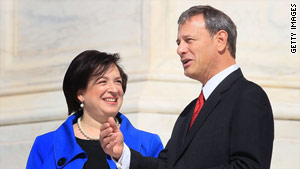
The same is true of every other mogul or corporate group with enough spare funds to fuel a Super PAC. Maybe the new addition of Elena Kagen- whose first official day as a justice last week marks the unprecedented presence of three female justices- will result in the Court reassessing the role of corporations in the increasingly money-based political system, but, in all likelihood, it won't.


[Photo credits: CNN.com and WashintonPost.com]
Read more »
4 com

We Shouldn't Have To

Tyler Clementi, an eighteen-year old college student in New Jersey, committed suicide last week after being harassed for being gay. Clementi's death follows those of Billy Lucas, age 15, Ashter Brown, 13, and Seth Walsh, also 13, all gay teens who recently committed suicide, purportedly due to constant bullying. Looking back further, Clementi's death has echos of the murder of Matthew Shepard in 1998, which lead to the enactment of hate crime legislation in several states, including the targeted deaths of gay men and women as hate crimes. These deaths are rapidly becoming the rule, not the exception, for gay youths.
Simply put, this is disgusting. The unhappy losses of these young people only further magnifies the central issue when fighting for gay rights in America: there is a culture in the country that tells children there there is something inherently wrong about being gay, something so heinously wrong about it that it's better to kill themselves than to live as gay men and women.
The blockage in the Senate of the repeal of Don't Ask Don't Tell is only another organization telling these children that because they are gay, they are not good enough. Not good enough to serve America, not good enough to get married.
We shouldn't have to tell LGBT youth not to contemplate suicide. We shouldn't have to tell them that they just need to 'hang on' through the harassment until it gets better, or that yes, they are just as important as everyone else. We shouldn't have to read stories or hear commentary about the deaths of gay youths. We shouldn't have to because the harassment shouldn't exist in the first place.
America must allow Clementi's death to do what Shepard's did in the 90s: make progress for the rights of the gay community. If not a change in the laws surrounding gay marriage, it must act as a motivator to finally repeal Don't Ask Don't Tell. It would be irresponsible for the US Senate to look at the influence they can potentially have upon gay youths like Clementi and not pass the retraction of Don't Ask Don't Tell. The change of this policy could, quite literally, save lives- not only in the military, but also at home. It could validate to scores of gay youth their importance to America, and if that is a possibility at all, it is worth it to repeal just for that. Using Clementi's death to repeal Don't Ask Don't Tell would not be politicizing it. It would be possibly saving some other Tyler Clementi out there from committing suicide because he didn't think he was good enough.
Read more »
0 com

The West Bank

Without an Israeli extension of the building freeze at the West Bank, Palestinian compromise was somewhere between improbable and impossible. This was understood- or said to be understood- by pretty much everyone involved in peace talks early this month. And yet, the Israeli government did not continue the freeze. As American leaders attempt to compromise with the nations' leaders, construction is already underway on the West Bank.
General optimism for the talks was minimal, to be fair. But this new development doesn't necessarily destroy the proceedings. While a complete solution being reached during this next round of talks is unlikely, some progress is better than none. The US special envoy to the Middle East has already begun to restart talks with Israel to continue the freeze, at least until some compromise is reached by the Israeli and Palestinian governments.
And progress is still completely possible. The Obama Administration's new focus on Israel, combined with the newfound willingness of both parties to meet is conducive to some progress at least. The two-state solution, the plan most commonly discussed in connection to the conflict, has its supporters. In the plan, an independent state of Palestine would be created to coexist with a Jewish state of Israel. While this may be the most popular plan for the people- Palestinians are given their own nation to rule as they like, the Israelis do not have to accept Palestinians as a people, it may not be a solution to the violent conflicts that are currently going on. In fact, a two-state solution may cause violence to escalate.
In a practical sense, the one-state solution works best. However, the willingness for the Israelis to grant citizenship to the Palestinians is minimal, and the Palestinian leadership- if not the people at large- are less than interested in sharing power and land with the Israelis. So, that leaves a two-state solution. If the Obama Administration pursues a two-state solution during talks with the Israelis and Palestinians, they must work to bridge the gap between the two groups of leaders.
None of this will happen overnight. It may not happen for a long, long time. But some change in that area of the world is better than none, and progress- while no long-term substitute for a solution- could quell some of the violence and create an environment more conducive to the creation either of an independent state of Palestine or a nonviolent merge of the two peoples.

Photo via nytimes.com
Read more »
0 com

Filibustered!

It is incomprehensible as to how a legislative body, faced with the necessity of repealing a law that is declared unconstitutional, does not do so. And yet, yesterday Senate Democrats were unable to gather enough support to break a Republican filibuster against a bill that includes a proviso to overturn Don't Ask Don't Tell, the military policy limiting the service of gay soldiers that was recently ruled unconstitutional by a federal judge. Though Democrats courted the support of Maine Republican Susan Collins, who, rhetorically, is in favor of Don't Ask Don't Tell's repeal, Collins did not vote for cloture in the end, along with a handful of Democrats.

However, this legislative battle is unnecessary. Don't Ask Don't Tell was originally created through a presidential edict during the Clinton administration. Therefore, President Obama, as Commander-in-Chief of the military, could simply dissolve the policy. At the very least, President Obama could place a stay on Don't Ask Don't Tell, stopping soldiers from being actively discharged from military service until Congress reaches a policy agreement. President Obama has declared his support for the revocation of the policy, as have a majority of his military advisors, including Secretary of Defense Robert Gates.
President Obama has the means to and the political climate conducive to repealing Don't Ask Don't Tell. Between the military and policial leaders condemning Don't Ask Don't Tell and socially prominent figures, like Lady Gaga, leading an offensive against the policy, President Obama should have no political reason not to repeal the policy.
This fight is not about how Republican- and some conservative Democrat- elected officials feel about gay marriage. It is not about any mislead fears they might have about soldiers spreading "the gay", as Rachel Maddow calls it. It isn't even about public opinion about gay marriage or Don't Ask Don't Tell. This is one of those issues where public opinion shouldn't have much weight. Don't Ask Don't Tell is a fight over the most basic of American principles, equality. It is about one party fighting for equality and the other blocking it. It is not just unequal to bar gay soldiers from service, it is against everything that any fight for equality in America has stood for. 

[photo credit: cnn.com]
Read more »
0 com

Graph of the Week: Growth

Featured on The Huffington Post, Ezra Klein's Washington Post blog and The Rachel Maddow Show, this shows the growth of wealth under all Democratic presidents since 1948 (the blue bars) and all Republican presidents since the same time. Certainly, it is staggering. Not only did every income bracket grow more under the Democratic presidents, they each grew at a relatively similar rate with a slightly higher amount of growth for the lowest income group. That is how the economy should operate, as a mutually progressive rate that keeps wealth growing enough to encourage Americans to prosper but not to create such a division that the top percentile is the only one that experiences real growth. Under Republicans, the exact opposite effect occurred. Growth was uneven and polarized, with the top income bracket swelling (though not even growing as much as it had), and the others growing less and less in descending order. If nothing else, this is, in many ways, a validation of the economic policy of liberals in Congress who, for so long, have been treated as the party who didn't understand "real" America's economic problems. But as this chart so clearly lays out, spending works. It moves the economy forward, it creates jobs and it leads to an economic temprate where mutual prospering occurs.
In a chart, this is why who you vote for matters. And it raises the conundrum more clearly than any before it: why do so many low-income voters vote against their direct economic interest, especially when, like the tea party, they cite current financial conditions as a motivator for their vote?
Read more »
0 com

Some Light Summer Reading for Our Students

By Senior Correspondent Devon Maloney 
Boy soldiers, violent civil wars, crushing poverty, absent mothers, alcoholic fathers, galloping consumption, destroyed childhoods and young hardened killers are not what many consider ideal summer reading subjects for most teens laying on the beach.
Angela’s Ashes, the memoirs of Frank McCourt, set the mood for the rest of the book about his darkly dysfunctional family and his “miserable” upbringing with the opening lines, “[w]hen I look back at my childhood I wonder how I survived at all.”
Similarly heart wrenching was A Long Way Gone by Ishmael Beah, the memoir of a boy soldier fighting in the bloody civil war of Sierra Lèon in the late 90s. A Long Way Gone becomes a frightening look into the teen years of Ishmael who turns from a simple, happy rural school boy into a numb killer with the help of constant drugs that erased all of his ethics and human morals.
What do both of these sad stories have in common? They were mandatory summer reading assignments this year for rising freshman and sophomores in Fairfax County Public Schools.
However, this theme of ‘not-so-happily-ever-afters’ doesn’t just apply to what is assigned for summer reading by English teachers. During my recently completed freshman year we read the tragic Shakespeare drama of Romeo and Juliet, John Steinbeck’s un-uplifting novel Of Mice and Men, and Holocaust survivor Elie Wiesel’s Night.
What are our teachers trying to tell us? Are they saying life is “nasty, brutish, and short” as misanthropic philosopher Thomas Hobbes once said on the human condition?
Don’t get me wrong, I understand the position teachers might be taking in trying to tell their students that life isn’t all Northern Virginian bliss with strip malls and full refrigerators if they can, but is it impossible to have good, insightful, deep piece of literature that gives one a happy view of the world?
While I enjoyed and learned a lot from the book’s I’ve been assigned over the years in school, is it too naïve of me to ask for a lighter piece of literature? I’m hardly asking for teen novels about undead heart throbs or, worse yet, a Chicken Soup for the Teen Soul equivalent.
For example, Three Cups of Tea is a real life story that gives one an insight into modern day issues like the crisis in the Middle East and still leaving the reading with the feeling that there is good in the world while raising insightful questions, representing literary elements, and presenting easily discussable topics for a class room.
“The happy childhood is hardly worth your while,” McCourt said. Please teachers, don’t leave us to believe that unhappy books are the only literature that is worth our while.
Read more »
0 com

Popular Populists

Democratic ads heading into the midterms have taken an odd, if not unexpected turn. Liberals and left-leaning moderates have feverishly distanced themselves from the majority party's impressive political accomplishments this year and set themselves up to be angry, populist-style advocates for disenchanted voters, especially Republican ones. Some don't even note being a Democrat (Rep. Glenn Nye's, D-VA, rather conservative seeming video is below). The assumption, at least in Washington, is that the anti-incumbent, and, to a lesser extent, the anti-Democrat, sentiment in the country this voting cycle is so strong that detaching oneself from the many policy goals which were completed last year is the only way to survive the midterms.
To the contrary: many voters' biggest issue with the last Congress is what they consider its inability to bring progress to the nation. A representative who absolves him or herself of responsibility for what is, in actuality, an impressive repertoire of accomplishments, does not help their chances of re-election. If anything, they hurt them. Voters want to see something being done to fix the problems in America. Oftentimes, any action is better than no action
"Its about the conservative movement hating the Republican establishment," Rachel Maddow said of the supposed anti-incumbent attitude. She noted that there was no real comparison in the Democratic party. If this is true- and there are many examples of it being so (Delaware, for instance), then the fear among Democrats shouldn't be that they appear to be, well, Democrats. It should be that they appear to have wasted away the last year.
And they haven't. The Democratic congress accomplished a lot this year, and, for all of the legislations' faults, several of the decades-long Democratic goals were met. Truthfully, if the Democrats cannot learn to focus on their progress and the great things passed this year, they will lose the House, because voters- especially the much sought-after moderates- don't really care if you're a Democrat or a Republican. They care if you're getting things done.

Rep. Glenn Nye (D- VA): Path
Read more »
0 com

[Don't Forget the] Recovery

In March, we said:
In order to stimulate the economy, the US government must fund programs to provide jobs to American people, with a heavy focus on infrastructure spending. Infrastructure spending, or government funding of the building of roads, bridges, schools, etc, provides structure to America's crumbling infrastructure.
American buildings are falling apart. Destruction from natural disasters and simple age still ravage America's infrastructure, and the repair of roads and the like has become one of the most important issues today on a local level. America's buildings affect nearly every American every day, as they go to school, work, or home. The long term maintenance of failing infrastructure will result in incredibly high cost for the American taxpayer. If the problems are not immediately fixed, the financial consequences of quite literally rebuilding America will be great.
Additionally, infrastructure spending provides simple, viable jobs to US workers. In the current economy, with the shockingly high unemployment, workers are in desperate need of work that projects created by infrastructure spending will easily provide.
Often, the government will also hire small businesses to restructure the roads and buildings that must be repaired. Not only does that provide jobs, infrastructure spending funds small business, and, by extension, stimulates the economy on a national level.
Monday, President Obama proposed a 50 billion dollar transit spending plan, which is comprised mostly of infrastructure spending. Certainly, the plan is an important step in cementing the economy as President Obama's continued focus into the midterms, but also to confirm Obama's devotion to providing jobs for Americans. The plan includes an "infrastructure bank," which would be developed and run by the federal government but financed by both public and private investments.
This is the sort of plan that would pay dividends to the American people quickly and in large numbers, so the question arises as to why the plan is so small. Obama, as a senator, was a big proponent of plans like this one, so it isn't a policy-based trepidation on the part of the administration. The package was most likely set at a smaller size in hopes of gaining Republican votes, but didn't the President learn anything from the health care debate? Maybe if he set a higher goal, any 'compromise' set in Congress would be closer to what he actually wanted. Also, the administration was able to pass one of their main (if little-understood) policy goals, banking regulation, with a Republican filibuster and without conservative support. If there's anything that Republican congressmen are possibly inclined to support, it is a package like this one that will provide many jobs in their districts, even though conservative support for infrastructure spending is infrequent.
"1. It’s a good idea 2. It’s much too small 3. It won’t pass anyway — which makes you wonder why the administration didn’t propose a bigger plan, so as to at least make the point that the other party is standing in the way of much needed repair to our roads, ports, sewers, and more– not to mention creating jobs. Once again, they’re striking right at the capillaries," economist Paul Krugman wrote on his New York Times blog, Conscience of a Liberal on Tuesday.
Krugman is right. If only because of obstruction for obstruction's sake, passage- at least of this version- of the plan is unlikely. But this doesn't change the fact that the administration essentially threw away a good chance to appear completely in support of and devoted to creating jobs. Now, if the Obama administration wishes to use this economic focus to their advantage come November, they ought to try their hardest to get the new proposal passed.

[Photo credit: nytimes.com]
Read more »
1 com

New Media, Old Media

Sometimes it seems as though the favorite stories of newspaper editors are those about the impeding end of the newspaper business. It appears to be generally accepted that the way of the future is cable news shows and online, fast-streaming news, free or otherwise.
The problem with the switch Americans have essentially already made to online news is the true downfall of new media: it gives Americans what they want- exactly what they want- instead of what they really need. Cable and network shows cater to the wants of Americans, providing scandalous celebrity stories and airy fluff pieces. On the internet, the people are the station editors- they can choose Perez Hilton over CNN, Hulu instead of Paul Krugman. Today, no one is keeping Americans informed. For the first time, everyone has other options than just the news, and, subsequently, news shows and sites struggle as Americans become less informed.
The Huffington Post, the brainchild of Arianna Huffington, is, for many people, the biggest symbol of new media on the web. But even her site- widely respected as a news source- understands that to survive today, you've got to give people what they want, not just what they need. To be fair, the Huffington Post is probably one of the best at mixing the two, creating a site that not only has pop culture and the news equivalent of MacDonalds, but also one that offers commentary from the leading political minds on important issues. So some junk food in the media isn't bad- you just don't want to consume it exclusively.
Varied media sources are important, and there's nothing wrong with celebrity news sites like TMZ. It's just that, in the past, the 'TMZ'-eque stories were in papers that also provided hard news and expert commentary.
And media junk food isn't always what people think it is. Americans seem to think that commentary in the media- anything ranging from Glenn Beck to Paul Krugman to Rachel Maddow- is bad. That is not the case. Commentary is OK for the media, in fact, it may even be good for it. Sections of the media that are opinion based and acknowledge to be so have been around for a very long time, starting with editorial and opinion pages of a newspaper. And, after all, what is television new commentary but a live op/ed page? As long as editorializing is saved for commentary programs, it isn't a downfall of new media, nor is it even really new.
The new media outlets are, in the long run, good for the news industry. They open new doors and new outlets for publications and make information available in a way it never was before. There are innumerable positives that come with the boom of new media and, if harnessed correctly, it could lead to a more informed public. Today, however, that is not yet happening. New media outlets- if they want to do their jobs- need to give people what they need, not just what they want.

[photo credit: micropersuasion.com]
Read more »
0 com

Face to Face

As the combat mission in Iraq comes to a halt and the many recent Afghan controversies seem to have cooled off, the administration, in an effort spearheaded by the State Department, has taken up the Israeli-Palestinian conflict as the new international focus leading into the midterms. Which, without a doubt, is a noble task- many a president before Obama has tried and failed to aid these two parties to make a peaceful settlement, without any luck. By hosting a series of peace negotiations between Israeli Prime Minister Benjamin Netanyahu and Palestinian Authority President Mahmoud Abbas, Obama, as well as America, at least symbolically, is expressing commitment to a cease in the volatile relations seen between not only the groups militarily and politically, but also in the people personally. If the president and Ms. Clinton are able to work with Israeli and and Palestinian leaders and help them conclude their sparring and agree on a viable solution, the Obama administration will have taken a huge and notable step forward for peace across the Middle East. However, try though the president might- and, doubtlessly, will- any outcome other than the sort of stale noncommittal ending that is shoved aside later when shots are fired once again is unlikely, simply based on the past. This isn't to say that the president and Secretary of State Clinton have no chance, it's just that they can't- and won't, according to recent statements- force peace upon anyone. No matter how committed America is or becomes to peace in the world, it is the Israelis and the Palestinians who must choose peace. America cannot choose it for them. Last time talks were held, they led to the death of over a thousand Palestinians as well as many Israelis. That being said, the tentatively optimistic tone being taken by administration leaders bodes well for the talks, as no one has more politically to lose from this than the Obama administration. And the commitment given by all parties to meet again, soon, can only be a good thing.
There is no way that any talks can succeed, however, unless all parties understand a few key points. There must be some solution reached regarding Hamas, as Israel's main concern is its security, the underlying theme in all of the Israeli rhetoric this week. If Israeli security is strengthened, the Israeli leaders must accept the creation of a Palestinian state. There is currently no real Palestine, forcing huge numbers of people to lived displaced in remote communities, movement controlled by Israel. This is not a long-term solution, nor is this helpful in any way to Israeli security. Soon, a state of Palestine must coexist with Israel.
As with most issues, the ramifications of an agreement reached-or lack thereof- do not simply affect Israel or the Palestinian people, nor even just the groups in attendance at the talks. The conflict, as well as any two-state solution, causes tremors far outside the Israeli boarders. This is why the issue cannot afford to wait any longer or disintegrate once again. It is imperative, for the future of the Middle East, that something is done.
Read more »
0 com

President and Prisoner

On Friday, former President Carter returned from Pyongyang, where he had traveled to free an American man imprisoned by North Korea for alleged illegal entrance of the country. The man, Aijalon Mahli Gomes, is only the latest example in a string of high-profile detainments of Americans by the North Korean government for similar alleged crimes. Robert Park, for whom it seems that Gomes entered the country, was detained in December after visiting North Korea in order to expose poor conditions at prison camps and freed in February, and he followed the arrest and eventual release of two American journalists last year. Never before has the lack of US involvement in any way with the North Korean government been this obvious or this crippling to both the Americans who suffer in prisons for extended periods of time because of the non-presence of the US in the nation and to the nuclear goals of America.
Over the past few months, the American government (along with the UN) has begun to lay out new sanctions in response to North Korean plans and actions that violate international nuclear treaties and limits. However, US-sponsored sanctions upon North Korea are nearly useless. America engages in no tangible trade with the North Koreans; the governments' only interactions are verbal back-and-forths about the US/South Korean military drills and any incidents that happen between the North and South Koreans. The only country that could truly make a difference in North Korea economically would be China, who seems minimally interested in cutting ties economically or diplomatically with the nuclear hotspot they boarder.
Unfortunately, even if the other members of the UN, including the US, were all to agree on economic sanctions in North Korea, nothing would be implemented. China is a permanent member of the Security Counsel, and therefore has a veto vote.
The US must either begin to directly engage the North Koreans (although, due to the American involvement in the South Korean war drills, any beneficial relationship seems unlikely) or begin lobbying China heavily to partake in an economic isolation of the country. It is unlucky that, because of recent economic practices, America has minimal pull with China, but perhaps an agreement will be reached, for one must be reached if any nuclear limits are to be enforced or economic sanctions be carried out.
Read more »
0 com

Distance Makes the Heart Grow Fonder

It is traditional in America for a former president’s mistakes to be essentially forgiven the moment he leaves office, mostly out of respect for the position but also from a slight inclination to forget bad sections in American history. From Hoover to Clinton to Bush Sr. to even Nixon, once the president is out of office and is writing their nearly guaranteed book deal and doing PSAs for whatever the day’s crisis is, Americans tend to forgive whatever discrepancies- moral or political- happened under the prior administration. The same is true for the George W. Bush administration. As with many other previous presidents, the Bush administration has been essentially romanticized in the mind of Americans. Once considered an abject failure by most of left-wing America, the media and moderates in the country and a mild embarrassment by right-wing America, who worked throughout the 2008 campaign to keep Bush out of the public eye as much as possible, the actions of the Bush administration are becoming generally accepted, if not lauded.

But we are forgetting the reasons the Bush administration was considered a failure in the first place- and not for the reasons usually mentioned. Yes, the post-Hurricane Katrina cleanup and rescue was a complete disaster and a disgusting example of federal irresponsibility. Yes, the lies told to the American people after 9/11 about the situation in Iraq were truly heinous and led to shocking overreach by the executive branch, including the disregard for the rule of law seen throughout the presidency. Yes, the international relations that had taken years and many administrations to carefully build were essentially destroyed- but these are not the only major, crippling shortfalls of the Bush administration, nor are they the oversights that impacted the nation most in the long term.
The Bush administration set a reckless and shocking precedent for executive power in America. From the overwhelmingly political motivations of the Bush advisors to the president’s increasing trust in and funding of corporations and special interests, the entire presidency was political in a way that had never been seen in the White House before. Although plenty of past administrations have been political and made political deals- as it is nearly impossible to operate in Washington without being political to some measure- never before had a presidency dealt so much in politics instead of ideology. The administration was very conservative except when that ideology conflicted with the special interests they had financially promised to protect.
While it may seem superfluous to dwell on past mistakes of a former president, it is actually important that these trials are remembered and used as a lesson. The quicker that the bloating of executive power that occurred under George W. Bush is forgotten, the more likely any future president will be able to return to such unprecedented power. President Obama seems to have taken a very expected ‘forgive and forget’ policy when it comes to dealing with the prior president. However, Bush’s policies that last today are, therefore, being ignored rather than repudiated. President Obama needs to gain the political courage to take firm stances against Bush administration policies- both politically and legally. If he cannot or does not do this, there is nothing, no precedent to stop future administrations from acting in the dangerously unbalanced manner of the executively control-crazed former administration.
(Photo credit: newsone.com) 
Read more »
1 com

The Real Tom Robinson

In Harper Lee's sole novel, To Kill a Mockingbird, a young black man- Tom Robinson- is falsely imprisoned for the rape of a privileged white girl. Robinson was killed by the prison guards after making an attempt to escape. Now, a 45 year old black man who was prosecuted for the rape of a white woman has been released from prison by a judge following prosecutors'reexamining of the case and introduction of DNA evidence which cleared his name. Michael Green, the ex-convict, has been offered 2.2 million dollars as reparations and to keep him from bringing a civil suit against the state.
Like last year's case in Texas (the same state where Green's case took place) where a man was sentenced to the death penalty and executed after new evidence had been discovered that could clear him of all charges- and which eventually did so, after his murder- Green's case was radically altered after the introduction of DNA evidence. While onus lies with the prosecutors for the (unintentional) introduction of false evidence during Green's original trial, there is no way they could have know that their eyewitness was lying or deluded. In 2009, over 3,000 men and women were on death row, and Texas alone had over 300 inmates waiting to be executed. Many of them were convicted before DNA evidence was customary to introduce by police or prosecutors.
Green, obviously, was not waiting on death row. But the way in which his case was reexamined cannot be unique to inmates who are simply imprisoned- which is not to say that that is any less horrible a fate. Green's experiences in prison were, frankly, traumatizing, as they are for many felons.
Prosecutors make mistakes. Judges are not infallible. Jurys have their own biases and baggage they bring to the case. The death or long-term imprisonment of an innocent man or woman is a horrific and life-altering mistake that can be fixed. If more DAs act like Patricia Lykos, who worked on Green's case and continues to look at all innocence claims filed, perhaps less time and lives will be lost within a broken system.
However, no true change can be made until the way in which people are executed in this country is reexamined. Unless it can be, without a doubt, guaranteed that not a single person on death row is innocent (which is practically impossible for prosecutors to do), the death penalty must be abolished. Killing innocent people just because they were once thought to be guilty is not something that can continue to be a practice in America. The US is one of the few developed nations who still executes their prisoners, and this is not something to be proud of.
There is no way to ensure that cases like Green's do not happen. Nor is there a way to ensure that only the guilty are killed. America ought not to be the only world leader who kills their inmates- much less the only who kills innocent ones.
Read more »
1 com

Civil Rights in Afghanistan: The Military is Not the Solution

Once the 'other' war, the American conflict in Afghanistan is now the nation's focus. The New York Times released a report last week declaring counter-insurgency, the strategy launched under President Bush and carried into today's administration, a failure in the eyes of high-ranking military officials and noting the military's move away from counter-insurgency towards targeted assassinations of Taliban leaders, adding to the voices implying concern with the current actions in Afghanistan and providing tangible evidence to back up Americans who are growing increasingly disenchanted with the war.
The Obama Administration already has a 2011 deadline to leave Afghanistan, and it seems as though they will stick to it. Yet, even as Americans become very anti-war, reports like a recent Newsweek cover featuring 'the girl with no nose', a young Afghan woman who had been legally maimed for leaving an arranged marriage, have raised concerns that have been growing for the future of people's rights- especially those of women- if America leaves now. Women in Afghanistan's lives have improved lately, but they are still so far from equality that it is inhumane. Considering the way the US has been involved in Afghanistan, America has a responsibility and a moral obligation to ensure the safety of and promote the equality of Afghan women.
So although America's time as a military presence in Afghanistan may be reaching its end, a heavy diplomatic influence can both secure America's national interests and safety as well as encourage progress for Afghan women's rights, especially if Secretary of State Hillary Clinton acts as the face of America in Afghanistan. Ms. Clinton has a unique ability and opportunity to both pressure the Afghan government into providing and inspire the Afghan women to work for women's rights, along with the diplomatic tools she possesses to attempt to reduce violence against women, something the American military was never really able to do. If, as it seems with the rejection of counter-insurgency, the military is unable to to carry out the traditionally civilian roles of nation-building and education that counter-insurgency requires, then allow the State Department to take over operations in Afghanistan and act as a diplomatic force promoting equality and women's rights.

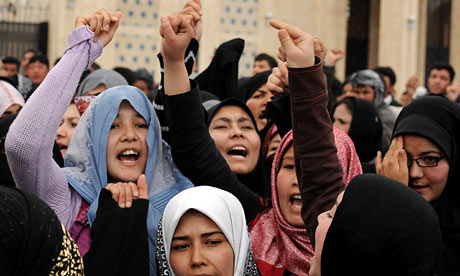
[Photo credit: The Guardian] 
Read more »
3 com

Prop 8

Nearly two years ago, voters in California did the unprecedented: they took away someone's rights for the first time in US history. Proposition 8, put on CA ballots after a judge ruled that the state had to allow same-sex marriages, ended gay marriages in California. Almost immediately, protests and lobbying began from both sides of the issue, including extensive focus from the entertainment world. Very quickly, the Proposition 8 law was challenged in court in Perry v. Schwarzenegger.
The trial was not able to be watched by the American people, as cameras were blocked from the proceedings, and little was known about the in-case testimony except what was leaked out through social networking sites. Judge Vaughn Walker's decision Wednesday overturned Prop 8 and the decision made by California voters, although, due to appeals, will not be enacted imminently.
Basic civil rights- including the rights to marry, to have a family, to serve in the military, or numerous others denied to LGBT citizens- are not something to be awarded to specific groups of people. They are not something that people are allowed. Civil rights are automatic and each and every person in the United States- and in the world, for that matter- deserve them. Ending Prop 8 or even allowing gay marriages nationwide would not end the sort of discrimination that LGBT people face on a daily basis, but it would be a huge step forward. For years, African-Americans, Native Americans, women, and many other minority groups fought for representation, equality, and nonviolence. While even today some of these groups still face certain discriminations, the progress made over the past fifty or so years has been incredible. In another fifty years, it is doubtless that Americans will look back upon the fight for gay rights and discrimination against LGBT people, especially LGBT youth, as a blight upon the national history in the same way segregation and the Jim Crow Laws are.
The violence and taunting that have become dangerously mainstream against LGBT people is only propped up by laws like Proposition 8 that treat gay people as different from everyone else, therefore making it 'okay' to treat them differently, even violently. Treating gay people like this is not any different from beating someone for being black or tall or red-haired or Jewish. Prop 8's arbitrary treatment of LGBT people as unequal to everyone else make it unconstitutional, and it's repeal will be the first step of many towards true equality for all people. 
Read more »
0 com

Getting Better

The economy, no matter what else can be said about it, is both undoubtably improving and not yet where it ought to be. While a lethargic Congress is unable to squeeze out anything remotely resembling a follow-up to the promising yet incomplete economic recovery bill, it's still difficult to tell how much more and what kind of recovery is needed, due in equal parts to the general ambiguity of the economy's signifiers for stability and the reluctance of Congress to re-approach the issue. Instead of taking real steps to continue to ensure the stability of the American economy, elected officials have taken to either singing the praises of what they consider to be an already recovered economy, or have begun to relentlessly bemoan the status of the market without offering any, much less any helpful, solutions.
Many people, including economists, look at stocks to prove the health of today's economy, rather than unemployment numbers or other signifiers, the reasoning behind this being that stocks, while not exactly a measure of the spending or financial security of the American people, act as a tangible measurement for the health of American business (or, rather, America's corporations). However, stocks are designed to both rise and fall- nearly always both in one day. If you were to take a year's measure of the stock market as comparable to the health of the economy, it is possible you could achieve an accurate- if far from full- picture. Days, months and even quarters of dips and swells in the market do not prove anything about the economy in the long run, except that it is stil working on some level.
Other analysts use the unemployment numbers, the job creation rates, the national debt or the GDP to measure the economy. Truthfully, no one number will provide a full view of the shortfalls and surges in today's market. Still, it is doubtless that, while the US economy has improved greatly, it is still not in a 'normal' or stable state.
Therefore, shouldn't Congress be doing more? Since Capitol Hill has become effectively allergic to anything that involves national spending, even that of the most rationalized kind, spending that feeds directly back into the economy, economic bills have been few and far between. The state-aid bill passed by the Senate today is certainly progress, but not quite enough. It's Congress' job to spend on the American people, so it would be beneficial for elected officials to get over their fear of using money meant to help Americans to actually help Americans.
Read more »
0 com

Fringe Movement

One of the wonderful things about the strong upholding of personal freedom in America is the complete diversity of views that is ensured and even nurtured. Never will the federal government be able to deny true freedom of speech, and never should they. While the American government is far, far from perfect, the freedoms that are protected in the US are truly one of the most perfect parts of the system.
Because of this liberty, there will always be people who are out-there and fringe movements and polarizing groups. However, there is a difference between, say, the John Burch Society, who believe that fluoride in drinking water will lead to government-sanctioned, secret doses of birth control flowing out of city wells, and a Florida church called ‘The Dove World Outreach Center’ which is planning what they call “International Burn a Quran Day” on September 11, 2010.
Sure, everyone has the right to his or her opinion. However, not only are the Dove World Outreach Center’s actions against the most important post-9/11 message our country received- effectively, that unless we can restructure our inter-faith and international relations, we can expect terrorist attacks, not only upon us but also our allies, because we cannot find a way to communicate with other nation’s governments- but they are dangerous to our national security.
The US government has worked for years to set relations on a positive tone with prominently Islamic Middle-Eastern governments. Today, with American troops stationed in Afghanistan and still in Iraq, with the unsettling nature of the US relationship with Pakistan, it is imperative that, if the American goal to end, or at least smother acts of terror in that area of the world is to be achieved, these relationships are preserved and strengthened, not torn apart by American disregard for the fact that few Muslims actually support the Taliban, that it is a fringe movement not unlike the KKK years ago in the US.
Beyond the security concerns, the Dove World Outreach Center’s plan is born from the sort of hate that breeds violence in America. While it may be legal for the group to go about burning whichever book they feel like- that is, after all, one of the importantly protected freedoms in America- this sort of religious anger is what has torn apart countries in the past. Still today in Israel, battles are fought between two of today’s leading religions, creating an unsafe and, frankly, frightening atmosphere, all because religious cannot learn to coexist.
Read more »
0 com

Quote 8/3/10


Anthony Weiner 

"If you believe this is a bad idea to provide healthcare, then vote no. But don't give me the cowardly view that 'oh if it was a different procedure'.."

Read more »
0 com

Leak

The one thing President Obama did not need following the resignation of General McChrystal was another scandal in Afganistan. And yet, with the unearthing of thousands of wartime documents from 2004 onwards that paint a bleak picture of the war and tell of a double-dealing Pakistani government, it seems that the tide will turn rapidly against the already unpopular war, both at home and with the "shocked" Afghan leaders.
Although the Pakistani Intelligence officials have already refuted the yet-unconfirmed documents that detail alleged exchanges with the Taliban where the Pakistanis conspired against American forces, including attempts to assassinate Afghan officials. The American government has been careful when dealing with the Pakistani officials in the past, and there is a serious risk of diplomatic problems if these documents turn out to be legitimate. If the Pakistani government is as close to the Taliban as the documents imply, the American government could find itself in a dangerous position.
The Obama Administration has stayed firm on its decision for an end date in Afghanistan. Today, especially in the face of these new materials that show a war that, if to end with America's goals completed, is far from over, the Obama Administration faces criticism of the 2011 end date from both sides. At the same time, Americans are growing more distasteful of the war that seems endless and increasingly useless.
Popularity should not define a president's decisions, especially in terms of foreign policy. Still, when the midterms are so close, it's likely that the pubic's opinion will influence the President's- and Congress'- choices.
The Obama Administration has already begun to feel the public pressure to extract the American forces from Afghanistan, and, if not to completely leave, also extreme pressure to reexamine the counter-insurgency strategy President Obama reaffirmed his belief in by nominating General Petreus for the vacancy left by General McChrystal. The doubt in the current path is not just from the outside- Administration insiders are beginning to question the policy.
Now, President Obama has two options. He can either move the exit date up and remove forces from Afghanistan as quickly as possible, or he can impart, somehow, knowledge to the American people that refutes or overrides these documents, proving the Afghan war successful and moving in a positive- and eventually terminable- direction.
Read more »
1 com

Excess

Last year, failing banks handed out billions in bonuses to executives after taxpayers had bailed them out, rationalized by politicians calling these banking conglomerates 'too big to fail'. Now, the Obama Administration and Congress have taken a major, sweeping step towards ensuring that no bank is to big to fail and that never again will a late-night vote taken by Congress lead to taxpayer dollars being shoveled into the pockets of bloated banks.
The banking regulation reform bill orchestrated by Senator Chis Dodd and Representative Barney Frank, for whom the bill is named, will protect American consumers more than any financial regulations in history. In the past, nearly a dozen shrunken agencies were tasked with protecting consumers in different areas of the complex financial market. Resultantly, some areas were overprotected, with the bureaucratic mess making true consumer advocacy nearly impossible, while other sectors of the market were left completely untouched. Now, one reaching organization will protect Americans from all practices in the financial markets. Additionally, tough restrictions will provide new stability in the markets while pruning practices that endanger Americans.
Still, this bill is not quite as reaching as it ought to be. While in theory banks may now be 'too big to fail', this only applies to taxpayer bailouts. Banks can still combine and bloat, becoming impossible to regulate by any agency. Gramm-Leach-Blily, the law that allows consumer banking to meld with banking insurance companies and insure themselves is still enacted, creating a dangerous investment for consumers who assumed their finances were protected. Also, though regulation is now tougher than ever, the government is still unable to insure against taxpayer-hurting practices, like Wall St. banks frivolous handling of the TARP funds last year.
Even though the new law is far from perfect, it offers protection to consumers like never before. If the current regulations had been enacted a few years ago, the Goldman-Sachs fraud case would have been either more sparse or would have not happened at all, due entirely to the creation of the new protection agency.
Read more »
The Liberal Hype site claims no credit for any images featured on this site unless otherwise noted. All visual content is copyrighted to its respective owners. Liberal Hype is in no way responsible for, or has control of, the content of any external website links or embedded streaming videos. Information on this site may contain errors or inaccuracies. If you own rights to any of the content and wish to have it removed please contact at liberalhype@gmail.com. My Tangled Tale, Vinyl, The Dull Drama, First Draft Magician, and other partners are produced by respective owners, and Liberal Hype claims no connection to any information they publish.